Youth football injury claims may involve new questions in California after the passage of Assembly Bill 708. Governor Gavin Newsom signed the bill on September 28, 2026, expanding protections for young tackle football players who want to use additional safety equipment.
The law requires youth tackle football leagues, youth sports organizations, and coaches to allow participants to use safety equipment, including soft-shelled add-ons placed over football helmets.
The change does not make football injury-free. It also does not mean a soft-shell cover can prevent every concussion or head injury. Instead, the law prevents organizations from broadly banning a type of safety equipment that parents and players may choose to use.
For families, leagues, coaches, and attorneys reviewing a serious injury, AB 708 adds another factor to consider when examining safety policies, helmet rules, concussion procedures, and evidence after an accident.
This guide explains what the new law changes, what it does not prove, and what families should preserve after a serious youth football injury.
How AB 708 Changes Youth Football Safety Rules
California already regulates youth tackle football through the California Youth Football Act and related health and safety laws.
Existing rules include limits on full-contact practices, helmet reconditioning requirements, concussion education, and procedures for removing athletes who may have suffered a concussion or head injury.
AB 708 adds another layer. A league, youth sports organization, or coach cannot prevent a participant from using qualifying safety equipment simply because the organization prefers not to allow it.
The legislation specifically mentions soft-shelled helmet add-ons.
Safety Add-Ons Now Have More Legal Protection
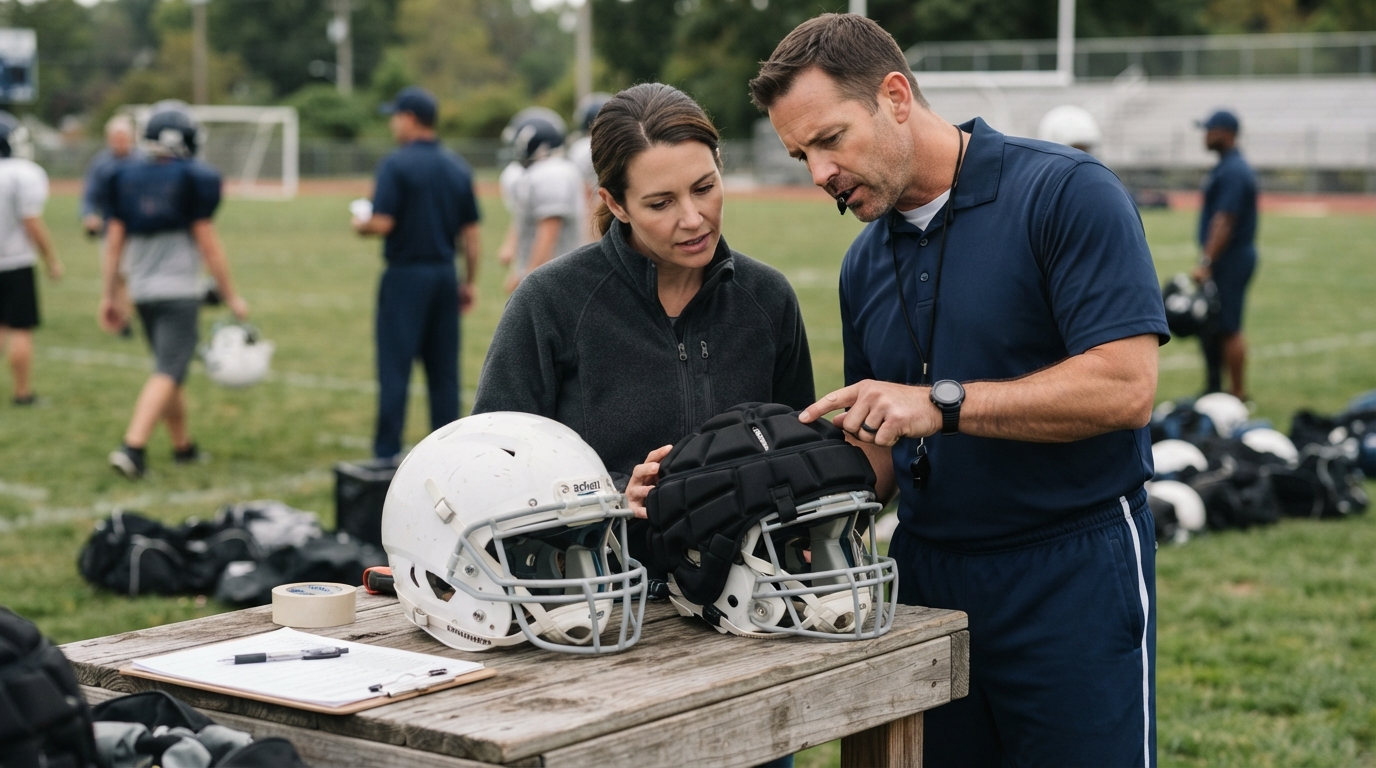
Soft-shell helmet covers are padded attachments worn over a traditional football helmet. They are designed to add another layer between the helmet and outside contact.
Parents have increasingly asked whether their children can use them during youth football practices or games. Some organizations previously restricted or prohibited their use.
AB 708 addresses that conflict by requiring covered leagues and organizations to allow youth participants to use safety equipment, including these soft-shell add-ons.
The law also permits a court to issue injunctive relief when an organization violates or threatens to violate the requirement. A prevailing plaintiff who obtains qualifying injunctive relief may also recover reasonable attorney’s fees and costs.
Soft-Shell Helmet Add-Ons Cannot Simply Be Banned
The central idea behind the new law is parental and player choice.
A youth football organization may still have legitimate safety procedures and equipment standards. However, it cannot simply prohibit the use of covered additional safety equipment when the law requires that equipment to be allowed.
The final legislation also addresses concerns involving helmet warranties and safety certifications.
For football helmets put into play on or after January 1, 2027, the use of a soft-shell add-on does not automatically void the helmet’s warranty or safety certification. The enacted language includes conditions tied to whether the add-on substantially damages the underlying helmet.
This provision matters because some organizations had raised concerns that adding equipment to a helmet might affect certification or manufacturer protection.
Parents should still follow the helmet manufacturer’s instructions and confirm that any add-on is appropriate for the specific equipment being used.
Additional Equipment Does Not Guarantee Protection From Concussion
AB 708 should not be interpreted as proof that a padded helmet cover will prevent every head injury.
Football involves impacts from tackles, blocks, falls, collisions with other players, and contact with the ground. A concussion can occur even when a player wears properly fitted protective equipment.
Helmet technology may reduce certain impact forces, but no football helmet makes the brain immune to injury.
That distinction can matter in youth football injury claims. The presence or absence of a soft-shell add-on should not replace a broader investigation into how the injury happened.
Investigators may also need to review coaching practices, tackling technique, medical response, prior symptoms, equipment condition, and whether the player was removed after signs of concussion appeared.
Readers who need a broader introduction to injury law can review Understanding Personal Injury Law: Rights and Responsibilities.
How Liability May Be Evaluated After a Youth Football Injury
A serious sports injury does not automatically mean that a coach, league, school, or equipment company is legally responsible.
Contact sports involve risks. The legal analysis often depends on whether someone acted negligently, violated a relevant safety obligation, provided defective equipment, ignored a known danger, or failed to follow required concussion procedures.
For example, a claim may raise questions if a player showed obvious concussion symptoms and was sent back into a game without appropriate evaluation.
Another case may focus on defective equipment. A separate claim might involve dangerous field conditions or conduct outside the ordinary risks of the sport.
A Rule Violation Can Matter Without Automatically Proving Negligence
If a league violated a safety rule, that fact may become relevant evidence. However, a rule violation does not automatically answer every question about civil liability.
An injury claim still needs a connection between the conduct and the harm.
Suppose an organization improperly refuses to allow a helmet add-on. That violation may support part of the factual investigation. It does not automatically prove that the add-on would have prevented the specific concussion that later occurred.
Medical evidence, biomechanical evidence, witness testimony, video, helmet condition, and expert analysis may all become important.
The same principle works in the opposite direction. A league cannot automatically claim that it met every safety obligation simply because the player wore a soft-shell helmet cover.
Equipment is only one part of youth football safety.
If an injury eventually leads to litigation, our step-by-step guide to filing a personal injury lawsuit explains how evidence collection, filing, discovery, negotiation, and trial generally fit into the process.
What Families Should Preserve After a Youth Football Injury
Medical care comes first when a child suffers a suspected concussion, neck injury, fracture, spinal injury, or other serious trauma.
Symptoms such as confusion, repeated vomiting, worsening headache, loss of consciousness, weakness, seizure activity, unusual behavior, or difficulty waking require prompt medical attention.
After immediate medical needs are addressed, families should preserve evidence while events are still fresh.
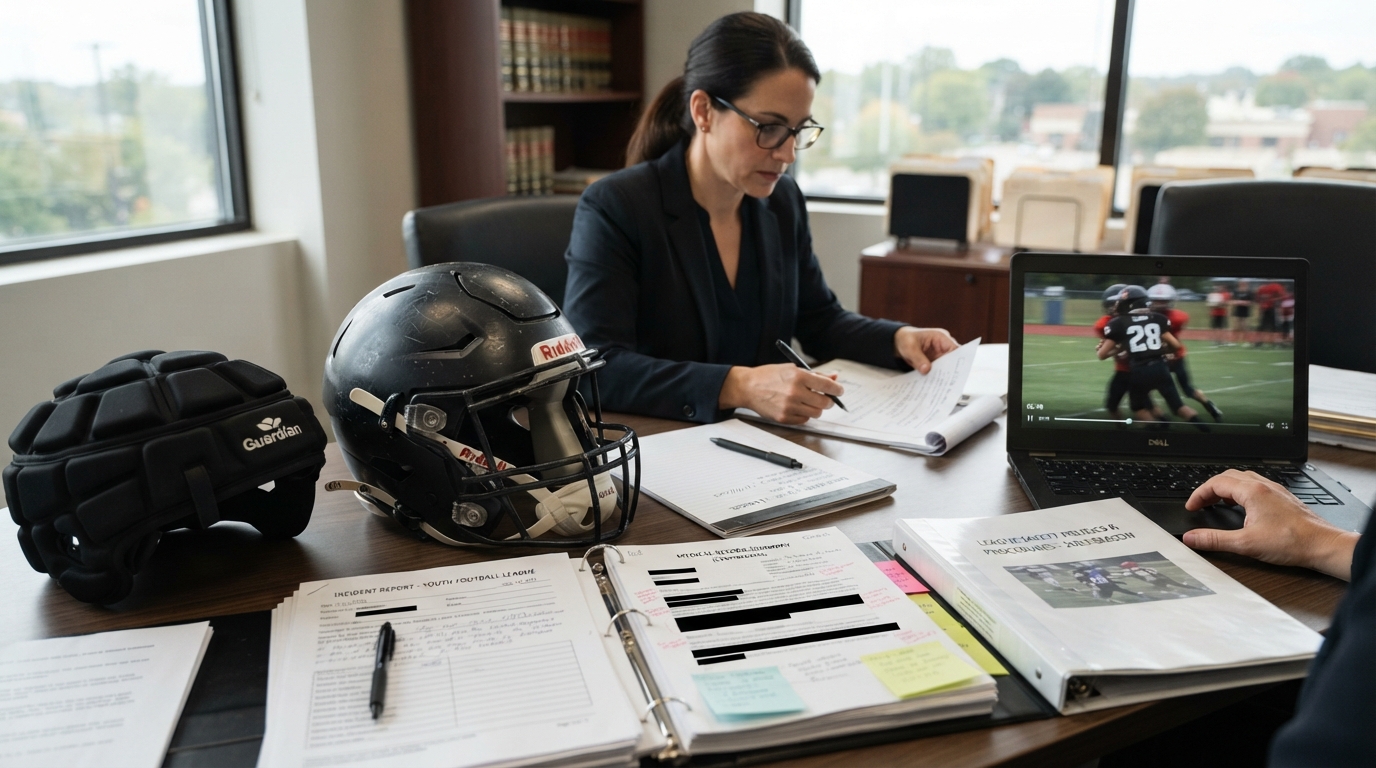
Sports organizations may have video, incident reports, practice schedules, equipment records, medical forms, or written safety policies that become difficult to locate later.
Preserve Medical Records, Video, Equipment, and League Policies
Start by documenting what happened.
Write down the date, location, practice or game, position played, type of contact, and symptoms noticed immediately afterward.
Save medical records, imaging, discharge instructions, school restrictions, physical therapy records, and follow-up recommendations.
Identify witnesses. Other parents, players, coaches, trainers, officials, and spectators may have seen the collision or observed the athlete’s behavior afterward.
Video can be especially useful. Games may be recorded by the league, parents, streaming services, schools, or individual spectators.
Ask that important recordings be preserved before they are deleted or overwritten.
Keep the Helmet and Safety Add-On in Their Post-Injury Condition
Equipment can become evidence after a serious head injury.
Do not immediately discard the helmet, padding, chin strap, or soft-shell add-on when equipment performance may be disputed.
Photograph the helmet from several angles. Capture the certification labels, model information, visible damage, add-on placement, chin strap, and interior padding.
Keep purchase records, reconditioning documentation, manufacturer instructions, and league equipment records when available.
A qualified professional may need to determine whether the helmet was properly fitted, maintained, modified, or damaged.
Families should avoid attempting destructive testing or modifying the helmet themselves after a serious injury.
Digital information can matter too. Fitness trackers, heart-rate devices, or connected health records may document activity changes during recovery. Our article on wearable device evidence in personal injury claims explains both the potential value and privacy concerns surrounding that data.
If a claim progresses, damages may include medical costs and other losses depending on applicable law and the facts of the case.
Settlement discussions can also involve disputes over the severity of the injury, future care, liability, and available insurance coverage. Our guide to how personal injury settlements work explains the general negotiation and release process.
Youth football injury claims
The most important lesson from AB 708 is not that one piece of equipment solves the problem of youth football injuries.
The law instead adds a specific protection: covered California youth football organizations must allow athletes to use safety equipment, including soft-shelled helmet add-ons.
That requirement sits alongside existing concussion education, athlete-removal rules, contact-practice limits, helmet maintenance requirements, and other safety measures.
For parents, it creates an opportunity to ask better questions before a season begins. What helmet does the league provide? How often is it reconditioned? Are soft-shell add-ons allowed? Who handles a suspected concussion? What is the return-to-play procedure?
For injury investigations, the same questions may help establish what happened after a serious incident.
Youth football injury claims can involve medical evidence, safety policies, equipment, coaching decisions, video, witness testimony, and sometimes product issues. No single fact should replace a complete investigation.
AB 708 adds a new piece to that larger picture.
Readers can review the state’s announcement through the California Governor’s official AB 708 announcement.
This article provides general educational information and does not constitute legal or medical advice. Sports-injury liability, concussion claims, product liability, assumption-of-risk rules, insurance coverage, and filing deadlines depend on the specific facts and jurisdiction.